Thursday, October 20, 2022

LAST LESSONS #112 – LAST THINGS – PART 1

 “For we are his workmanship, created in Christ Jesus for good works, which God prepared beforehand, that we should walk in them.” Ephesians 2:10

As my life shortens, I realize that I have not finished everything that God has planned for me. If I had finished God’s plans for me, he would have taken me home! Since he hasn’t, apparently there are some last words I should say, some last work for me to complete, some last things I need to do, some last advice I could give, and even some thoughts I should be thinking as my life closes. 


Last week I wrote you about one of the “works” I want to complete—that is to send thousands of Bible commentaries to Africa.


This week, it’s “advice” about the upcoming election. Obviously, we all need to vote in this mid-term election. Not to vote is to give non-qualified candidates the chance to determine our political future. Therefore, we Christians need to make our voices heard. That’s the first thing.


But who we vote for should be extremely important to Christians. Because I am a pretty simple person, I narrow my decision on which candidates to vote for to those who stand for the two issues that the Bible speaks about quite clearly—the issue of abortion and the issue of homosexuality. Both of these moral issues will be on the ballot because all the candidates have made a stand on them one way or another. If you do not know what individual candidates believe about abortion or same-sex marriage, it is important to find out before you go to the polls. That’s not to say that the economy is not important, or the problem at our southern border, or school choice. But the Bible doesn’t speak to those things. If we are honest, we admit that we cast our ballot about those less important issues depending on how they affect us personally at the time. Not so the issues of abortion and homosexuality. These reflect not only our worldview but our religious beliefs. It separates Christians from non-Christians. It separates those who know what the Bible says and want to obey it from those who either don’t know what the Bible says or don’t want to obey it. 


Christians must vote for candidates who are against abortion, because abortion is murder, plain and simple. Exodus 20:13; Matthew 5:21; Romans 13:9; James 2:11


Christians must vote for candidates who are against same-sex marriage because sex between two people of the same gender is homosexuality, plain and simple. 1 Corinthians 6:9; 1Timothy 1:10; Romans 1:18-32.


My prayer is that we Christians will not be distracted by non-moral issues such as inflation and immigration that come and go and then forget the moral issues that count for eternity. If God thought murder and homosexuality were important enough for him to condemn in his Book, then we should be wise enough to vote on God’s side. 


As for me, I will make sure I find out what each candidate thinks regarding abortion and any LGBTQ+ issues. I will vote in person as early as possible. And I will thank God that I live in a country where I can still vote.

Thursday, October 13, 2022

LAST LESSONS #111 – RJBF COMMENTARIES

“Blessed is the man who walks not in the counsel of the wicked, nor stands in the way of sinners, nor sits in the seat of scoffers; but his delight is in the law of the Lord, and on his law he meditates day and night.” Psalm 1:1-2

A few weeks ago, I had the pleasure of meeting with the Archbishop of the Church of Uganda (COU) Stephen Kazimba and Education Director Rev. Paul Kakooza. They visited Rafiki, and one evening Karen Elliott and I were able to take them to dinner. As we spoke, I was struck by the gratitude these men had for Rafiki and the Rosemary Jensen Bible Foundation (RJBF). The RJBF, with Rafiki providing the shipping, has given Uganda thousands of Bibles. Every COU school that uses the Rafiki curriculum receives a Bible for every student and every teacher. Seminary students and pastors have all been given Bibles by the RJBF. The men from Uganda could not thank us enough for the Bibles and their “attitude of gratitude” was humbling. I was most impressed that they did not ask for anything personally. Yet, when I asked them what they needed, they asked for more Sunday School (SS) lessons and commentaries to help them teach in their churches. We had already sent them 500 packets of the Rafiki Sunday School lessons on MATTHEW, and their churches loved them. A packet contains lessons for adults and four levels of children and a commentary. When I asked them how many churches they had, they told me 10,000! Yes, ten thousand conservative Anglican (COU) churches in Uganda with more than 12 million members! But they had no Sunday School material and no commentaries to enrich their SS teachers except for what we had sent them—500 for 10,000 churches.

So that’s what I want to do! I want to give thousands of commentaries to SS teachers in Africa to go along with the SS lessons provided by Rafiki. The pastors will probably use these commentaries for preaching too! I want to give not only to Uganda, but to all ten countries where Rafiki has a Village. Would you like to help me? The RJBF is able to get excellent commentaries at a good discount from several Christian publishing companies. If we send only 1,000 packets of SS lessons with commentaries for each country, we need 10,000 of each commentary. The RJBF has already purchased 10,000 commentaries for GENESIS, MATTHEW, ACTS, and ROMANS. I am asking God if he would supply the funds for six more. (JAMES, EXODUS, JOHN, J0SHUA, 1 CORINTHIANS, and 2 CORINTHIANS).

This number of SS lessons would last the churches for a little over three years.

I have learned that commentaries are a wonderful way to help me meditate on the “Law of the Lord” and thus “delight” in his Word. I have also learned that our God wants us to ask him for BIG things—like thousands of commentaries! I wish I could buy the commentaries myself, but I know I can’t because I won’t be here long enough to earn that much money! But I will give to the RJBF what I can now and send this “treasure” on ahead of me in the form of Bibles and Bible commentaries.

I do not normally ask for money in my blogs. This is the first (and last!) time. But if you want to join me in this special effort to get Sunday school lessons and accompanied Bible commentaries in the hands and hearts of hundreds of thousands of people who really want them, please send checks to:

RJBF
PO Box 488
Eustis, FL 32727.

Your gift is tax deductible, and you will receive a receipt by email.

PLEASE SEND YOUR EMAIL ADDRESS.


Thursday, October 6, 2022

LAST LESSONS #110 – REVIVAL – PART 3

 “I have stored up your word in my heart, that I might not sin against you. Blessed are you, O Lord; teach me your statutes!” Psalm 119:11-12 

I promised to send a suggested order of Bible books to study for those of you who have been leading RBS Groups but didn’t get it out last week because of Hurricane Ian. Now here is the list. But what I am including in the list is a suggested commentary for each Book to enhance your study. As I have been leading my Group of RBS Seniors, I have learned that they are willing to go deeper in their study and they will do so if they have the resources. One of my Group members said that she does her lesson with her Bible open, her questions in front of her, and the commentary alongside her. She said she also has her cell phone handy to look up on Google the words she does not know. She says that her mind is just exploding with the knowledge she is gaining from Scriptures. She is in her eighty’s. 

The commentary that I suggest for the Book studied is written by someone other than the writer of the lesson notes. That way, your Group members study the Bible five ways: reading the passage, answering the questions, participating in Group discussion, reading the commentary, and reading the lesson notes.  Now that’s the way to learn! 

Here is the short list with information on each study:


Studying beyond this list, I suggest that Groups alternate between the Old and New Testaments. We have all 66 Books done including a suggested commentary, so choose any book you like.
 
Here are some words from a leader of one Group: 

“My name is Carrie French and I have been hosting Rafiki Bible studies in my home for 3 years. This has been a blessing to me and those who attend. (Our group has changed over the years as people come and go.) The ladies tell me this is just the type of study they have been looking for! A Bible study they “can sink their teeth into” and go deep into God’s word. The notes are wonderful! Thank you for making this Bible study available to us.” 
Carrie’s words encourage me tremendously as I pray for revival. My prayer is that every Group will encourage at least one member to start another Group so that the number of Groups will be doubled. Currently there are more than 700 RBS Groups. Will you pray with me that by this January there will be at least 1400 Groups all studying IN DEPTH the world-changing Word of God?

Thursday, September 22, 2022

LAST LESSONS #109 – REVIVAL – PART 2

 “I have stored up your word in my heart, that I might not sin against you. Blessed are you, O Lord; teach me your statutes!” Psalm 119:11-12

In this second blog regarding the importance of Bible study as we pray for REVIVAL, I want to encourage you with one person’s experience that came last week. She wrote:

“I think of you often and give thanks to our great God for the Rafiki studies. Today we began our third year of study. There are 10 of us and the women love the studies. There was joy and enthusiasm in returning for the study of Colossians. We had a new woman in attendance who expressed her gratitude in being there. Another is a young woman who is a recovering drug addict and also has other health issues. She has attended 2 years, but sporadically. The group has come alongside her with love and encouragement. She is coming along with good questions after weeks of silence. She had PT today and had to miss but texted me saying to please save her spot and that she will be there all remaining weeks. She is making the study of God's Word a priority, and her growth has been a blessing to the group. God has answered many prayers. Another young woman who came from a Catholic background and now is saved, was an avid golfer on the Country Club women's team. We meet on Thursday which is Women's Day at the CC. She gave that up for the study and adamantly would not hear of us changing the day of meeting. She has attended 2 years, today beginning her third.”

Isn’t it wonderful to see how the RBS has impacted people who have been coming for several years?

How about those of you beginning a Group? I promised that I would suggest an order of Bible books to be studied so I suggest you start with the Book of JAMES for the following reasons:

  1. It has only 8 lessons—members are usually willing to commit to 8 weeks.
  2. It is not hard—I have categorized all books according to difficulty as Beginner, Average, or Advanced. JAMES is a beginner category.
  3. It speaks to personal issues we face today—such as becoming wise, where arguments start, and taming our tongues.

Once you have finished JAMES, I suggest the following:

  1. GENESIS—because you cannot understand the Bible if you don’t know GENESIS.
  2. MATTHEW—because you cannot know Jesus if you don’t study MATTHEW.
  3. ACTS—because you need to know how the gospel was spread and how the church began.

Next week I will continue the list.

But this week, I want to encourage you to start a RBS Group or help someone else start one. You will never regret it. Why?

  • It will increase your own knowledge of the Bible.
  • It will make lasting friendships.
  • It will be the way God brings some of your members to faith in him.
  • It will give you opportunities to minister to those in need.
  • It will give you great joy as you come to know the Lord better.

And especially, it will be the way you can be a part of the revival that our country so desperately needs.

To find out about RBS Groups, check out www.rafikifoundation.org

Thursday, September 15, 2022

LAST LESSONS #108 – REVIVAL – PART 1

“The law of the Lord is perfect, reviving the soul; the testimony of the Lord is sure, making wise the simple; the precepts of the Lord are right, rejoicing the heart.” Psalm 19:7-8

If there was ever a time that our souls need reviving, a time when we need wisdom, and a time when we want to rejoice, it is today. I don’t know about you, but I dislike watching the national news because it is so discouraging. If the Lord does not return, we are bound for destruction unless God in his mercy brings revival. We can pray for revival, and we should, but only God decides when true revival comes.

In the Scripture and throughout history we read that God has most often blessed a nation with revival when the Bible is read and studied. When people read the Bible, they come to know their sinfulness leading to repentance. Revival always starts with repentance. And revival lasts as long as people continue to repent of their sins. God revives our souls as we repent from breaking God’s law.

Hopefully you are going to a Bible-teaching church and hearing good preaching where the need for constant repentance is proclaimed. But are you reading and studying the Scriptures at home? Every day? Are you systematically studying the Old and the New Testaments? Are you meeting with others so that you may be encouraged and that you may encourage others in knowledge of the Bible?

If we want revival, along with prayer, we must study the Bible that leads us to repentance.

There are some good Bible studies available today, but I believe the best one is the Rafiki Bible Study. I can say this because I did not write it! Knowing that I could never write a good Bible study, I asked 18 of my friends who were notable theologians to write lessons for adults on all 66 books of the Bible. Rafiki paid them (not anywhere near what they deserve to be paid!) and they wrote 553 excellent lessons! When they were finished, one of our writers had this to say:

“It is through his Word that God addresses us. It is his Word that instructs us, illumines our path, and nourishes our soul. This is why Rafiki put together this Bible study. Its aim is that we might learn to think our thoughts after God and walk in his ways. It is the most extensive, thorough, and edifying Bible study that I know about. I am delighted to be able to commend it.”—David F. Wells

Since we all want revival especially in this country, I am asking you to join me in starting a Rafiki Bible Study Group (made up of 5 to 10 people) or be a member of one—or both! By God’s grace, there are now over 700 RBS Groups meeting in the USA today and they tell me that they love it. The Groups meet in person once a week for approximately one hour. There is no teacher (only a leader) and thus no lecture to be prepared. Group members learn from the Bible itself and from discussing printed questions and reading printed notes. The leader purchases the lessons from Rafiki (www.rafikifoundation.org) in packets of 5 at the cost of $1 per lesson per person. Bible books differ in length.

Will you pray about starting a Group in your home, your church, your business place or wherever? Here are some suggested types of Groups:

  • Women
  • Men
  • Couples
  • Senior Women (large print)—I lead one of these!
  • Senior Men (large print)
  • High School Students
  • College Students
  • Business and Institution employees
  • Prison Inmates
  • Military men and/or women

I do not know how many people read this blog, but I do know that some of you lead or attend RBS Groups now. Would you be willing to write (in one or two short paragraphs) your experience and email them RMJ@rafikifoundation.org so that in succeeding blogs I can use your words to encourage others?

We need revival! We need to study the Bible to know what God is saying to us in this troubled time in our nation. Will you please join me in this for God’s glory?

P.S. My plan is to suggest a book order for study and good commentaries in succeeding blogs. 

Thursday, September 8, 2022

LAST LESSONS #107 – TANZANIA

“Ask of me, and I will make the nations your heritage, and the ends of the earth your possession.” Psalm 2:8

About Tanzania I could write a book! It’s where Bob and I lived for nine years. It’s where Bob took care of patients. It’s where I gave birth to two of my three children. It’s where Bob envisioned a hospital and raised the money to build it on the slopes of Mt. Kilimanjaro. It’s where I taught school. It’s where Bob drew all the plans for the 450-bed hospital known as the Kilimanjaro Christian Medical Center (KCMC). It’s where I came to know the Evangelical Lutheran Church of Tanzania and its bishops. It’s where I came to love Africa and its people.

Yes, I could write a book, but I will write only a blog to tell you how Rafiki was established in the beautiful nation of Tanzania.

When, in the year of 2001, Rafiki began the process of building orphanages in Africa, it seemed wise to place them in the capital city of each country. Therefore, I went to the capital of Tanzania which at that time was Dar es Salaam. (Today it is Dodoma.) I went to meet with the First Lady Anna Mkapa (Her husband, Benjamin Mkapa was president from 1995 to 2005) to ask her help in establishing an orphanage in Tanzania. She was interested and suggested that we locate on the coast close to Zanzibar. The problem was that most of the people there were Muslim and almost none spoke English. I was very discouraged and wondered if we were in the will of God. Our team decided to travel to Moshi to ask advice from Bishop Kweka, of the Evangelical Lutheran Church of Tanzania Northern District (ELCTND), who had helped us to start Rafiki years before.

When we arrived in Moshi, Bishop Kweka smiled and asked why we had gone to Dar es Salaam to build an orphanage. He said, “Don’t you realize that your home is here? We will provide a place for you!” I almost cried. Of course, God wanted us to be in our home area. And for several reasons.

  1. Moshi is in the Northern District of Tanzania which is the most productive because of Mt. Kilimanjaro and Mt. Meru. Tanzania is almost on the Equator and therefore would be very hot—except for the altitude in the Northern District. Mt. Kilimanjaro has an elevation of 19,341 ft and Mt. Meru is 14,967 ft high. Between the two (about 60 miles) the land, with an elevation of about 4,000 feet, is well-watered and fertile. What this means for Rafiki is that fresh fruits and vegetables are always available. And so is water. Kilimanjaro is snow-covered year-round and therefore as snow and ice melt, water comes down the mountain. The climate is perfect for a Rafiki Village that has an orphanage and schools.
  2. Moshi is in the Northern District where Bishop Kweka presided over the ELCTND. He could provide property on which Rafiki could build a Village. And he was true to his word. Although Rafiki had sent out doctors to work in KCMC, and another missionary couple, George and Donna Faulhaber, to teach BSF classes, the Faulhabers were not able to secure the land that Rafiki would require. But again, God used the church! The Lutheran Church gave Rafiki 50 acres of the most beautiful land imaginable. It is on the slopes of Kilimanjaro with a breath-taking view of the mountain’s snow-covered peak.

That does not mean there were no problems. There were two huge problems: language and poverty. When Tanzania received its independence from Britain in 1961, there were over 100 languages spoken in Tanzania. The national language at the time of independence was English but few people were English-speaking. The new government under the presidency of Julius Nyerere, wanted to unite the people. Because of commerce, especially along the coast of East Africa, the trade language was Swahili, therefore, Nyerere decided that government and higher educational institutions would use English, but that the rest of the Tanzania would be Swahili-speaking. This did not work very well because most of the people were not educated and preferred to use their own local languages. Nyerere made a mistake in not insisting that English be the national language as Kenya and Uganda did. Swahili is a well-developed language, but not spoken outside East Africa, so Tanzania has difficulty communicating with the rest of the world even to this day.

The other problem in Tanzania is their poverty. Julius Nyerere was a soft-spoken, gentle, idealist who loved his people, but he believed that his country should become socialistic. He didn’t know that socialism never works. Under socialism foreign investment slowed down, taxing businesses caused them to move to Kenya or Uganda, and lack of funds for infrastructure made movement of natural resources for export very difficult. The Chinese came in and built some roads, but they used only Chinese workers. Today Tanzania is one of the poorest countries in Africa.

Even though these problems continue to exist, Rafiki is firmly established in Tanzania. A beautiful Village is built facing Kilimanjaro with more than 3,000 bougainvillea planted around the perimeter for added security. Bougainvillea bushes have lots of thorns! The dedication of the Village occurred on November 6, 2007, with Bishop Kweka doing the honors.

I have learned that what God starts, he finishes. Never did I imagine when Bob and I went to Tanzania in 1958 that in 2022 there would be a Rafiki Village there where orphans are housed, children are taught with classical Christian education, teachers are trained, and widows make beautiful products that are marketed in the United States. Only God can do that. He may take a long time to complete what he starts, and Rafiki in Tanzania is not complete even yet. There are still buildings to be built.

But I am grateful that in 2017, I was able to go with my children and grandchildren to participate in the dedication of Rafiki’s Institute of Classical Education building complex. It was my last trip to Africa and a great finale for me—but not for Tanzania. Who knows what God will do there in the days and years ahead.

I am thankful to the Lord for letting me live long enough to tell part of this amazing story. 


Thursday, September 1, 2022

LAST LESSONS #106 – RWANDA

“Ask of me, and I will make the nations your heritage, and the ends of the earth your possession.” Psalm 2:8

Rafiki in Rwanda actually started in Kenya. When Mwai Kibaki was president of Kenya (2002-2013), his wife Lucy invited me to be a speaker at the 2003 conference of OFLA (Organization of First Ladies of Africa) held that year in Kenya. Lucy had visited the Rafiki Village in Nairobi and was impressed at how Rafiki was caring for and educating orphans. She wanted me to tell First Ladies in other countries about Rafiki. Of course, I was delighted to do so! At the conference I saw Janet Museveni, First Lady of Uganda, where Rafiki had already established a Village. She grabbed me by the hand and dragged me to meet Jeannette Kagame, the First Lady of Rwanda. I found out later that Janet and Jeannette were good friends and together they had started OFLA.

Jeannette Kagame invited me to come to Rwanda where she would host our team to discuss the establishment of a Rafiki Village. She was true to her word and escorted us to the hotel and dinner she had arranged for us in the capital Kigali. Jeannette Kagame was (and is!) a gracious lady.

She made arrangements for us to see some of the beautiful countryside of this small country of less than 10 million people at that time. And she wanted us to learn their history. Therefore, we visited the Genocide Memorial where in 1994 over 800,000 people were slaughtered in just 100 days. If you do not know this history, I suggest that you read up on it. There have been a number of books written about the genocide, the most popular, made into a movie, is Hotel Rwanda. Others include “Life Laid Bare,” the story of a community of genocide survivors who spent the months of killing hiding in the swamps near their homes in Nyamata. The reason to read this book is because the village Rafiki finally established is in the town of Nyamata.

The genocide in 1994 left the country poor. It obliterated the country's economy, social fabric, human resource base, and institutions. To this day almost 90 percent of the population lives on less than US$2 per day and half of the population lives on less than US$1 per day.

Jeanette Kagame, knowing the situation in her country, was eager to have Rafiki help. Therefore, she found a piece of property for Rafiki but the property was only 12 acres. We wanted to be appreciative, but it just was not enough land for a Rafiki Village. When the government could not come up with other properties, we went to the CHURCH. That’s always where God directs us!

The EPR (Eglise Presbytérienne au Rwanda) has an interesting history. The Church was founded in 1907. That year, Germans from the Bethel Mission accompanied by Tanzanians came to Rwanda. After the departure of the German missionaries at the end of the First World War, they were replaced by Swiss and Belgians and later Dutch missionaries. In 1959 the name was officially changed to Presbyterian Church in Rwanda so that the church would not be seen as only presenting the gospel, but also meeting the social needs of the country. Rafiki would fit into their goals.

The head of the EPR was one of the nicest church leaders I have met. He told us that the church had “reasonably flat” land in Nyamata, 22 miles from the capital of Kigali. When we went to see it, we were thrilled. The 44-acre site was perfect and the road into it was lined with the most beautiful bougainvillea hedge I have ever seen. There was even a small church at the entrance to the road to our property. It would have been perfect except for the fact that there was no electricity or water on the property. Minor details!

In 2007 Rafiki sent missionaries Ken and Bev Merrill to oversee the construction of the first phase—including getting electricity and drilling a well! Sorry, we drilled several wells to get water, without success. Apparently, being on a hillside means you must drill very deep to find water. Today Rafiki buys water from the community around us. We also buy electricity from the government, and it is expensive!

Another problem was bricks for building. They were not available. So, our innovative missionaries bought a cement mixer and made our own bricks!

One other big problem had to be overcome—the language. President Kagame declared that English would be the national language after the genocide. However, the people only spoke Kinyarwanda or French. And at that time there were no teachers who could teach English.

But nothing stops God. “Though troubles assail us --- the Lord will provide.”

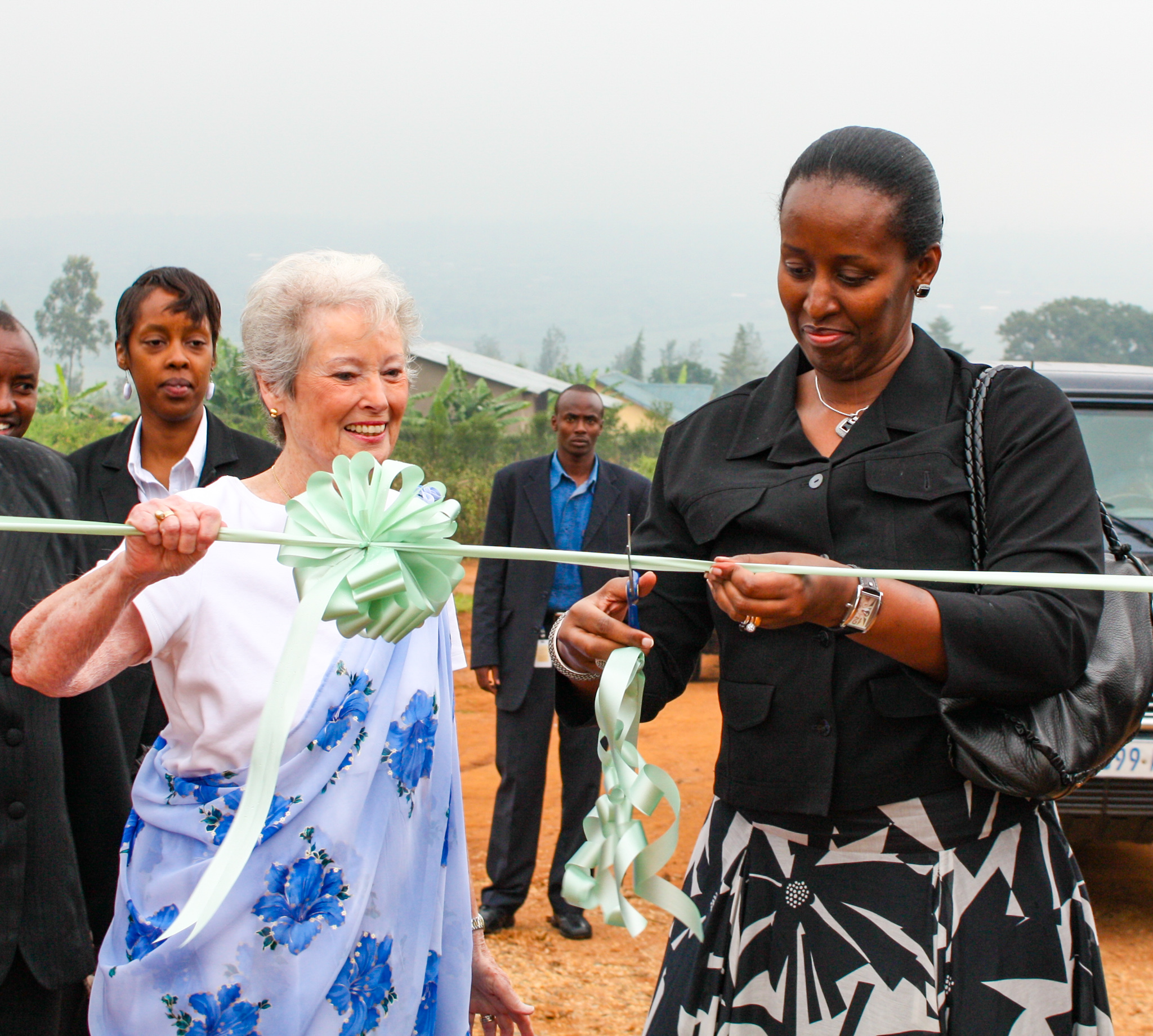
Thus, on February 25, 2009, the Rwanda Rafiki Village was dedicated by Jeanette Kagame. And it is flourishing with hundreds of children on the waiting list to get into our schools where they will be taught in English!

To God be the glory!

LAST LESSON #249 — IN MEMORIAM

Dear friend of Rafiki, It is with profound sadness, yet deep gratitude and hope in Christ, that we share the news of the passing of Rosemary...